 KEY HIGHLIGHTS
· Monazite concentrate containing the most critical and highly valuable heavy rare earth elements Dysprosium (Dy), Terbium (Tb) and Yttrium recovered from four planned pits in the Kasiya DFS mine plan, including pits scheduled for Year 1 production.
· DyTb and Yttrium oxide ratios in the Total Rare Earth Oxide (TREO) basket ~7-times higher than world’s five largest rare earth producers.
o Average 2.5% DyTb and 11.8% Yttrium within TREO basket vs. 0.4% DyTb and 1.7% Yttrium across the five largest rare earth producers.
o Highest ratios of up to 3.1% DyTb and 17.2% Yttrium found near-surface (0-6m).
· U.S. Department of War describes heavy rare earth supply chain risk as “a clear and present danger to our national security” – Assistant Secretary of War for Industrial Base Policy Michael P. Cadenazzi Jr., testifying before the Senate Armed Services Committee, 24 February 2026.
o MP Materials Corp., America’s only fully integrated rare earth producer, reports no measurable Dy, Tb or Yttrium.
· Western supply-chain decoupling has accelerated as DyTb and Yttrium subject to Chinese export controls.
o On 20 April 2026, USA Rare Earth, Inc. agreed to acquire Serra Verde Group for ~US$2.8 billion, underpinned by a 15-year U.S. government-backed offtake with floor pricing.
· Monazite potentially a third revenue stream from the non-conductor tailings stream of the DFS flowsheet – potential for no additional mining and no new primary processing circuit – confirmation of this is in progress.
· Independent report shows potential pricing of US$16,000/t base case (US$19,000/t high case) in 2026 (real), vs April 2026 Shanghai Metals Market benchmark spot monazite price (min 54-55% TREO grade) of US$6,142/t for a monazite product with identical TREO as these latest results.
Managing Director and CEO Frank Eagar commented:
“These results confirm that the monazite-hosted rare earth content first reported in January 2026 is present in pits scheduled for the early years of production at Kasiya. The monazite concentrate contains all four magnetic rare earth elements – Neodymium, Praseodymium, Dysprosium and Terbium – plus highly critical Yttrium. These elements appear to be recoverable from the current tailings stream of our DFS flowsheet. We are advancing the additional mineralogical and metallurgical work required to quantify the potential economic upside to the DFS reported last month.“
Sovereign Metals Limited (ASX:SVM; AIM:SVML; OTCQX:SVMLF) (Sovereign or the Company) is pleased to announce significant heavy rare earth metallurgical testwork results at its Kasiya Rutile-Graphite Project (Kasiya or the Project) in Malawi. The testwork was conducted on monazite concentrates recovered from four pits in the Project’s Definitive Feasibility Study (DFS) mine plan.
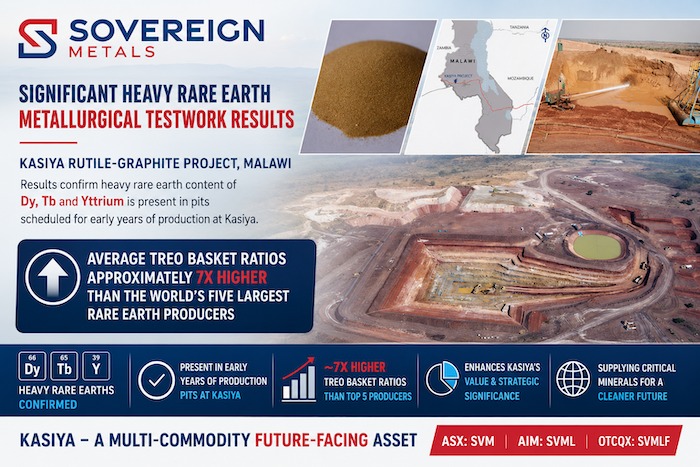
The results confirm that the heavy rare earth content of Dy, Tb and Yttrium first reported in January 2026 (See ASX Announcement dated 21 January 2026) is present in pits scheduled for the early years of production at Kasiya, with average TREO basket ratios approximately 7x higher than the world’s five largest rare earth producers.
Heavy rare earth content is highest in the near-surface (0-6m) which returns DyTb and Yttrium ratios within the TREO basket materially above those of the deeper horizon.
Table 1: Summary Results
|
Pit |
|
Light REE |
Heavy REE |
|
|
NdPr (%) |
DyTb (%) |
Y (%) |
||
|
Babbler |
21.0 |
2.6 |
11.7 |
|
|
Kingfisher |
20.5 |
2.7 |
12.5 |
|
|
Sparrow |
20.9 |
2.5 |
11.9 |
|
|
Mousebird |
21.2 |
2.4 |
11.3 |
|
|
Kasiya Four-pit Average |
20.9 |
2.5 |
11.8 |
|
|
Near Surface (0-6m) |
19.3 |
2.9 |
15.4 |
|
|
Deeper (6m+) |
21.6 |
2.3 |
10.3 |
|
|
Top Five Producers Average REE Content |
19.4 |
0.4 |
1.7 |
|
Note: Kasiya Four-pit Average calculated as average of per-pit TREO basket ratios. See Appendix 1 & 2 for source detail.
The findings come as the U.S. accelerates efforts to decouple heavy rare earth supply chains from China – a supply-chain risk the U.S. Department of War has described as a matter of national security.
Kasiya, already at DFS stage with a US$2.2 billion pre-tax NPV8, contains the four magnetic rare earth elements plus highly critical Yttrium recoverable from the DFS flowsheet as a potential by-product alongside rutile and graphite.
An independent price report for a monazite concentrate has been prepared based on the composition of a 60% TREO basket. Due to the exceptionally high proportion of heavy rare earths within Kasiya’s TREO basket, the independent report has identified the potential for a premium to benchmark monazite prices. The 2026 forecast base-case price is US$16,000/t (high case US$19,000/t), against a current benchmark monazite concentrate (54-55% TREO grade) price of approximately US$6,142/t based on the Shanghai Metals Market.
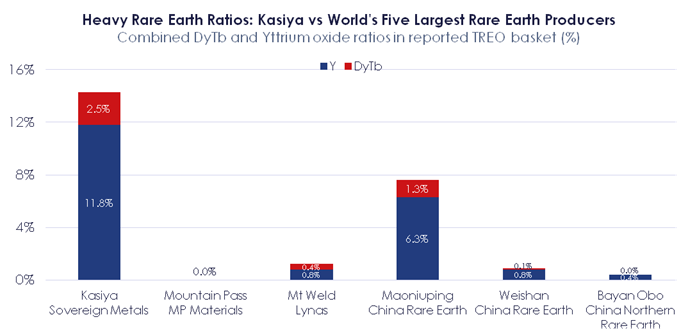
Figure 1: Combined DyTb and Yttrium content in the TREO basket of Kasiya monazite concentrate (four-pit weighted average) vs the rare earth assemblages reported by the five largest global rare earth producers
(Sources: See Appendix 2)
STRATEGIC IMPORTANCE OF DYSPROSIUM-TERBIUM AND YTTRIUM
Dy and Tb are heavy magnet rare earths essential for high-temperature permanent magnets used in advanced defence systems, precision weapons, aerospace applications and next-generation electric drivetrains.
Yttrium is a high-impact rare earth element critical for aerospace thermal barrier coatings, radar and laser systems, high-performance alloys and semiconductor manufacturing.
On 24 February 2026, the U.S. Assistant Secretary of War for Industrial Base Policy, Michael P. Cadenazzi Jr., testified before the Senate Armed Services Committee that on heavy rare earths China controls 95% of global output, with the U.S. importing almost 100% of what it uses – 90% of that from China. Mr Cadenazzi stated that this control provides Beijing with the ability to weaponize these supply chains, describing the situation as “a clear and present danger to our national security.”
China’s April 2025 export controls on Dy, Tb and Yttrium created immediate supply tightness for Western manufacturers. On 6 January 2026, China announced strengthened export controls on dual-use items to Japan, effective immediately. Despite 15 years of diversification efforts, Japan remains approximately 60% dependent on Chinese rare earth imports, and for heavy rare earths Japan’s dependence on China approaches 100%. The U.S. is 100% reliant on imports for its Yttrium requirements.
Western Supply-Chain Strategy: Market Context
The strategic value of non-Chinese heavy rare earth supply has been crystallised by recent corporate activity. On 20 April 2026, Nasdaq-listed USA Rare Earth, Inc. (USA Rare Earth) announced a definitive agreement to acquire Brazil’s Serra Verde Group (Serra Verde) for approximately US$2.8 billion. The acquisition is underpinned by a 15-year 100% U.S. Government backed offtake agreement, with contractual price floors of US$110/kg for both Neodymium (Nd) and Praseodymium (Pr), US$575/kg for Dy and US$2,050/kg for Tb.
Upon announcing the acquisition, USA Rare Earth described Serra Verde’s product as containing a high percentage of all four magnetic rare earths, “including the most critical and highly valuable heavy rare earths Dysprosium, Terbium and Yttrium.” USA Rare Earth also positioned Serra Verde as the only producer outside Asia capable of supplying all four magnetic rare earths at scale, and noted that Serra Verde has secured a US$565 million mine development finance package from the U.S. International Development Finance Corporation.
On 20 January 2026, U.S. uranium and rare earth producer Energy Fuels Inc. announced a US$299 million acquisition of ASX-listed Australian Strategic Materials Limited, expanding its mine-to-metal-and-alloy rare earth platform with the stated aim of becoming “the largest fully integrated producer of REE materials outside of China.”
These transactions crystallise the value that Western governments and capital markets now ascribe to scaled, non-Chinese rare earth supply. Kasiya’s monazite concentrate contains all four magnetic rare earth elements – plus Yttrium – at TREO basket ratios consistent with or exceeding benchmark operations, potentially recovered as a by-product of a project that is already at DFS stage with a US$2.2 billion pre-tax NPV8.
BY-PRODUCT ECONOMICS: NEAR-ZERO INCREMENTAL COST
The monazite concentrates reported above are recovered from the non-conductor tailings stream of the processing flowsheet specified in the Kasiya DFS. This is material that would otherwise report to tailings.
Recovery as a by-product of the DFS-specified flowsheet could potentially mean:
• No additional mining – the mine plan remains unchanged
• No new primary processing circuits
• No parallel rare-earth processing plant of the kind required by primary rare earth producers
• Monazite is isolated from the existing non-conductor product stream
• No additional reagents required
In aggregate, monazite concentrate recovery is potentially achievable at near-zero incremental costs relative to the DFS base case. Further work is required to assess the capital and operating cost implications of any downstream product separation or refining, and to characterise the mineralogy, deportment, liberation and radioactive element (uranium and thorium) handling requirements of the Kasiya monazite.
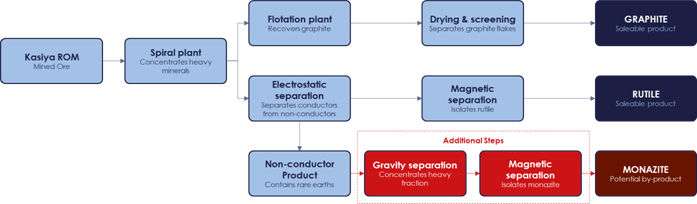
Figure 2: High-level DFS process flowsheet and additional potential steps required for a monazite by-product
KASIYA MONAZITE INDEPENDENT PRICE FORECAST
Project Blue Group Limited (Project Blue), a specialist in critical minerals market intelligence, prepared an independent price forecast for a monazite mineral concentrate containing 60% TREO.
Project Blue’s methodology values a contained Mixed Rare Earth Compound (MREC) within a concentrate using ex-China rare earth oxide prices, applies a payability factor reflecting commercial discounts, deducts for downstream processing and transportation to Japan as a Western-aligned ex-China proxy, and other realisation costs.
Table 2: Project Blue 2026 price estimates for a monazite concentrate with TREO distribution in line with that observed in Sovereign’s monazite testwork to date
|
Scenario |
Payability factor |
MREC value (US$/kg) |
Monazite concentrate (US$/kg) |
|
Base case |
60% |
39.49 |
16.00 |
|
High case |
70% |
46.07 |
19.00 |
|
April 2026 monazite concentrate price (54-55% TREO grade) |
6.14 |
||
Sources: Project Blue; Shanghai Metal Exchange (https://www.metal.com/Concentrate/202403260008).
Project Blue’s base-case forecast prices range from US$15.81/kg to US$16.00/kg over 2026-2028. High-case prices range from US$18.78/kg to US$19.00/kg over the same period.
Project Blue notes that prices for key rare earth products including NdPr oxide, Tb oxide, Dy oxide and Yttrium oxide are commanding a premium in ex-China markets relative to Chinese domestic prices, reflecting the limited pool of non-Chinese suppliers and ongoing decoupling of Western and Chinese rare earth supply chains.
The Project Blue forecast is independent commentary on potential pricing for a monazite concentrate with a 60% TREO. Sovereign has not entered into any offtake or sales agreement for monazite concentrate. Realised prices will depend on commercial negotiation, market conditions at the time of sale, the actual specifications of any concentrate produced and the terms of any offtake agreement.
SAMPLE PROCESSING AND METHODOLOGY
Monazite concentrates were produced from bulk sampling sites across four pits within the Kasiya DFS mine plan, namely Babbler, Kingfisher, Sparrow and Mousebird.
The Babbler bulk samples were extracted at two locations using a 700mm spiral auger and composited to represent planned pit depth or ROM feed material at each borehole location. The bulk samples were processed through the company’s pilot plant to produce a 45µm to 2mm spiral Heavy Mineral Concentrate (HMC). A 200kg portion of the spiral HMC was screened at 600µm and the resultant 45µm to 600µm sand fraction was processed over the Wilfley wet table to produce an HMC.
The Kingfisher, Sparrow and Mousebird bulk samples were composited from twin pit and Air Core (AC) samples at several sites within each pit. The pit composite bulk samples represent the 0m to 6m Ferruginous Pedolith (FERP) and Mottled Clay (MOTT) weathering units, while the AC bulk composites represent the +6m Pallid Saprolite (PSAP) and Saprolite (SAPL) weathering units.
The bulk composite samples of between 200kg and 1000kg were processed using mechanical vibrating screens to produce a 45µm to 600µm sand fraction which was further processed over the Wilfley wet table to produce an HMC.
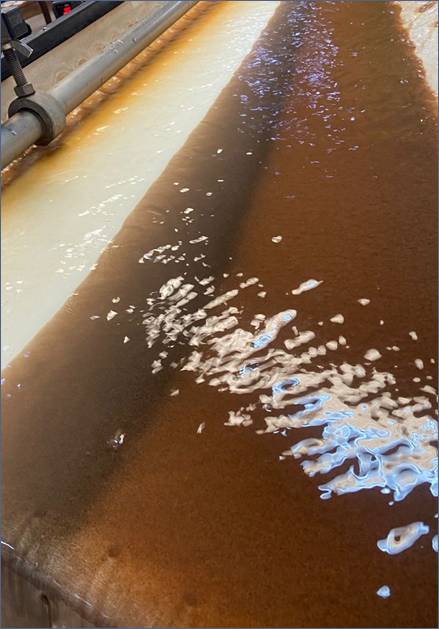
Figure 3: Monazite rich HMC clearly observable from gravity separation of non-conductor tailings (taken from samples disclosed in this announcement)
The Wilfley HMC of each bulk sample from the four pits were then processed through the Corona Stat electrostatic separator to produce a monazite-bearing, non-conductor product. A monazite-rich, non-conductor HMC was produced from the Wilfley table processing of each non-conductor product from which a final magnetic monazite concentrate was produced by magnetic separation. The monazite concentrates were sent for X-ray fluorescence (XRF) and Inductively Coupled Plasma (ICP) analysis.
NEXT STEPS
• Further detailed mineralogical characterisation of the monazite across the pits tested, including liberation, grain size and deportment of uranium and thorium.
• Additional metallurgical testwork to assess potential downstream processing pathways for the monazite concentrate.
• Characterisation of monazite grades and recoveries and marketable product volumes
• Study to assess the economic uplift from incorporating monazite as a bolt-on to the existing DFS flowsheet.
• Continued engagement with potential offtake partners and government stakeholders in relation to the heavy rare earth co-product opportunity.
|
Enquiries |
|
|
|
Frank Eagar, Managing Director & CEO South Africa / Malawi +27 21 140 3190 Sapan Ghai, CCO London +44 207 478 3900 |
|
|
|
Nominated Adviser on AIM and Joint Broker |
|
|
|
SP Angel Corporate Finance LLP |
+44 20 3470 0470 |
|
|
Ewan Leggat Charlie Bouverat |
|
|
|
|
|
|
|
Joint Broker |
|
|
|
Stifel |
+44 20 7710 7600 |
|
|
Varun Talwar |
|
|
|
Ashton Clanfield |
|
|
Link here to view the full announcement