GreenX Metals Limited (ASX:GRX, LSE:GRX) (GreenX or the Company) is pleased to present its Quarterly Activities Report for the period during and subsequent to 30 June 2025.
HIGHLIGHTS
· German Project – Tannenberg Copper Project
o The Company announced that it was initiating an historical core logging and sampling program at the Tannenberg Copper Project (Tannenberg).
o Core from 47 historical drill holes from the Tannenberg are now being comprehensively re-evaluated using modern exploration techniques.
o Program provides major opportunity to unlock untested copper potential given under-sampling of target strata in historical core, which presents significant discovery upside.
o Potential to discover previously unrecognised mineralisation in hanging wall limestone and footwall sandstones using modern analytical techniques.
o Additional high-resolution helicopter-borne magnetic and radiometric geophysics has now been flown over part of Tannenberg covering the historical Richelsdorf Mining District with results expected to identify important deposit-scale faults as well as the extent of historical underground workings.
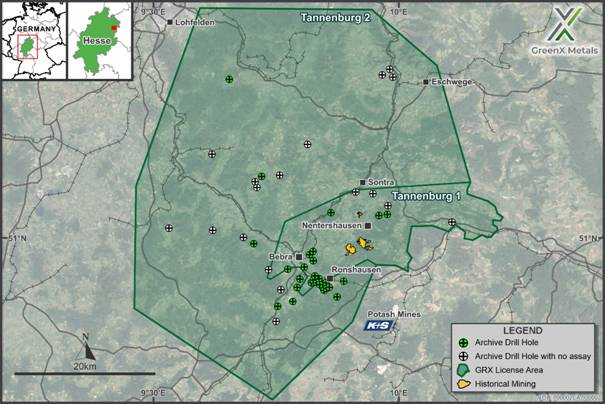
Figure 1: Distribution of historical holes selected for logging and assaying
o The Tannenberg area contains historically producing copper mines and multiple historical drill intercepts, with excellent potential for new discoveries of shallow (50 m to 500 m), large scale and high-grade copper and silver mineralisation, with much of the new expanded licence area remaining untested by modern exploration.
o Tannenberg exploration licence expanded seven-fold to 1,900km2 from 272km2 following grant of additional exploration licence at the project.
· Greenland Projects
o The Company notes the recent U.S. strategic interest in Greenland including Greenland Prime Minister publicly stating that he is open to discussions with the U.S.
o Greenland is endowed with an abundance of critical minerals which are essential for batteries, technology and defence.
o The Company is well placed to capitalise on the increased interest in Greenland with two large scale, strategic projects prospective for critical minerals located in Greenland.
Eleonore North Project
o Outstanding antimony results previously announced for the Eleonore North project in Greenland (Eleonore North or ELN).
o Antimony price now at US$60,000/t from historical prices of ~US$5,000.
o Critical mineral crisis escalating – China has now restricted export of critical and strategic antimony, graphite, gallium, germanium, tungsten, titanium and rare earths.
o Antimony and tungsten have been designated as “Critical Minerals” by the U.S. and the EU, with NATO designating tungsten as defence-critical for the Allied defence industry.
o Historical results from fieldwork at ELN include grab samples from outcropping mineralised veins with individual specimens grading up to 23% antimony (Sb), and other samples up to 4g/t gold (Au).
o Antimony mineralisation has been identified along a ~4km trend in veins and structures, that broadly aligns with previously identified gold veining at surface within a 15km trend.
Arctic Rift Copper Project
o The Company is targeting large scale copper in multiple settings across a 5,774 km2 licence at the Arctic Rift Copper Project (ARC).
o Further analysis on remote-sensing options underway which aims to improve understanding of the known copper mineralisation and to plan the next exploration program at the project.
· Arbitration Award
o In October 2024, GreenX was awarded up to £252 million (A$517 million/PLN 1.2 billion) in compensation from the successful outcome of the international arbitration claims (Claim) against the Republic of Poland (Poland or Respondent) under both the Australia-Poland Bilateral Investment Treaty (BIT) and the Energy Charter Treaty (ECT).
o Interest income of ~£14 million (A$29 million / PLN 68 million) per annum is currently accruing to GreenX. Against this, interest expense of ~£2.7 million (A$5.6 million / PLN 13.2 million) per annum is accruing on the US$11.3 million of litigation funding utilised.
o Since the award was made, Poland has lodged a request to set-aside the award with the courts of England and Wales in relation to the BIT Award and the courts of Singapore in relation to the ECT Award.
o The Company is strongly defending the set-aside motions with the hearing in Singapore for the ECT Award held subsequent to the end of the quarter.
ENQUIRIES
|
Ben Stoikovich +44 207 478 3900
|
TANNENBERG COPPER PROJECT (GERMANY)
Tannenberg is a large scale, relatively shallow and potential high-grade copper brownfields exploration project that is strategically located in the heartland of German industry.
Copper is currently recognised as a strategic raw material by the European Union.
During the quarter, the Tannenberg project was expanded, following the grant of a second exploration licence, to cover an area of 1,900 km2, a seven-fold increase from the 272 km2 of project area previously held.
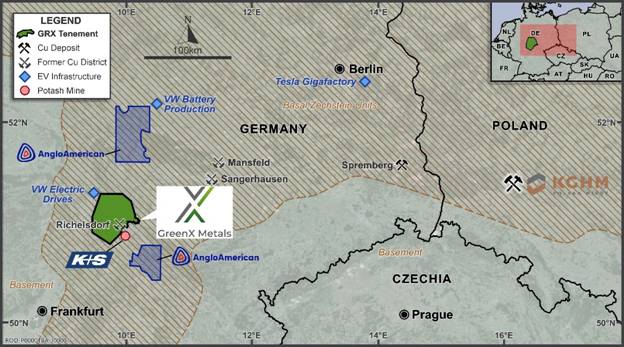
Figure 2: Tannenberg is located in the industrial centre of Europe within the Basal Zechstein trend
(brown shading)
In January 2025, the Company announced that it had been to participate in BHP’s 2025 Xplor program in relation to Tannenberg.
The Xplor program was established in 2023 to support promising minerals explorers to accelerate the exploration needed to support the energy transition. Over a six-month program period, BHP Xplor targets development of technical, business and operational excellence within participating companies.
As a 2025 BHP Xplor cohort company, GreenX has received a non-dilutive grant of US$500,000 and in-kind services, mentorship, and networking opportunities with BHP and other industry experts and investors.
Historical Core Logging and Sampling Program
During the quarter, a core logging and sampling program commenced with core from historical drill holes now becoming accessible for comprehensive re-evaluation using modern techniques. The work involves packing the core for shipment to a specialist European core logging facility, geological logging, sampling, assaying, and hyperspectral scanning of core from 47 drill holes from within the Tannenberg exploration licences.
Results are expected to confirm and expand known copper mineralisation. There is also potential for the identification of completely new mineralisation in 18 holes which have no recorded historical assays.
Modern understanding reveals potential for substantially wider mineralised intervals based on Poland’s world-class KGHM Kupferschiefer mines where copper mineralisation can be offset up to 30m above and 60m below the T1 shale horizon.
There is also the potential to discover previously unrecognised mineralisation in hanging wall limestone and footwall sandstones using modern analytical techniques.
There are strong indications of mineralisation extending beyond the historically sampled intervals already identified in the archived core including previously reported drill hole results:
· Ro 45 ends in 1% Cu after 2.7 m @ 1.6% Cu & 19 g/t Ag from 268 m
· Ro 22 starts in 0.67% Cu for 3.14 m @ 1.2% Cu & 15 g/t Ag from 436 m
· Ro 41 starts in 0.45% Cu at 414 m and did not fully capture hanging wall mineralisation
· Ro 38 ends in 0.37% Cu at 538 m and did not fully capture footwall mineralisation
A comprehensive 4km core logging and 2km assay program using advanced hyperspectral scanning technology is being completed which was not available to historical operators
The program further aims to establish an enhanced geophysical dataset through petrophysical measurements which will be used to optimise future exploration targeting.
Results from this historical core program are expected in the December quarter 2025.
AIRBORNE GEOPHYSICAL SURVEY
During the quarter, an airborne geophysical survey was conducted at Tannenberg which was designed to collect magnetic and radiometric data over the project area with results expected to identify important deposit-scale faults as well as the extent of historical underground workings to be used to plan for future exploration programs
A 602-line kilometre magnetic and radiometric helicopter survey was completed over a 58 km2 area at Tannenberg. Results from the survey will identify faults which play an important role in controlling mineralisation. Additionally, the magnetic data can verify the extent of the historical underground workings. Results of the geophysical survey will be analysed once the geophysical data processing is complete.
EXPLORATION WORK PROGRAMS
Other ongoing and upcoming key exploration programs at Tannenberg include:
· Analysis of historical geophysical data;
· Collation of historic mining and production data;
· Logging, assaying, and hyperspectral scanning of historical core; and
· airborne magnetic and radiometric survey (flown in May).
GREENLAND PROJECTS
Eleonore North Project
GreenX has previously announced that high grade antimony mineralisation had been identified at its Eleonore North project in Greenland, based on historical results recently released by the Geological Survey of Denmark and Greenland (GEUS). The historical results indicate the potential for a high-grade antimony-gold mineral system at ELN. Antimony prices have been on a rapid uptrend since China announced antimony export controls from 15 September 2024, with antimony prices in the US now having increased to over US$60,000/t from US$18,300/t2.
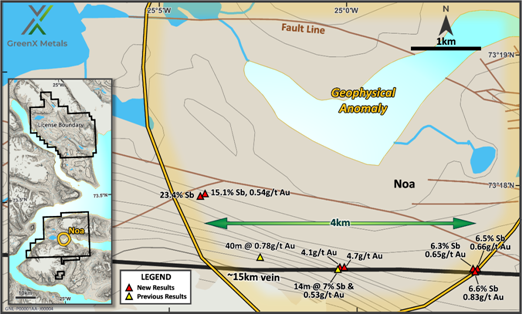
Figure 3: Released GEUS assay results show evidence for high-grade antimony and gold mineralisation above the interpreted Noa Pluton.
Historical data has confirmed the presence of gold and high-grade antimony in outcropping veins at ELN including:
· 14m long chip sample grading 7.2% Sb and 0.53g/t Au3
· 40 m chip line with a length weighed average of 0.78g/t Au3
Significantly, GEUS geologist’s identified stibnite (Sb2S3) as the antimony mineral. Stibnite is well-understood and the predominant ore mineral for commercial antimony production.
Antimony is designated a Critical Raw Material by both the EU and the US, with China being the world’s major antimony ore producer and major exporter of refined antimony oxides and metallic antimony.
Global strategic interest in antimony has significantly increased in 2024 due to several factors:
· China controls ~50% of global antimony mining, most downstream processing and 32% of global resources according to the Lowy Institute.
· China’s recent export ban on antimony, effective from 15 September 2024, has caused market disruption4.
· Antimony is a crucial material in the defence supply chain, used in various military applications including ammunition, flame retardants, and smart weaponry.
· Antimony is essential in renewable energy technologies including more-energy-efficient solar panel glass and in preventing thermal runaway in batteries.
The antimony market is expected to grow by 65% between 2024 and 20325. However, the supply side, declining antimony grades and depleting resources for existing mines are becoming increasingly relevant.
To aid the Company’s exploration targeting and fieldwork planning for ELN, GreenX’s technical team intend to locate, analyse, and study further historical samples and data within GEUS’s archives.
ANTIMONY RESULTS FROM NEWLY PUBLISHED GEOLOGICAL SURVEY ARCHIVE MATERIAL
GEUS’s archives host an extensive collection of rock samples (with and without assays), maps, as well as government and company reports going back many decades. A sub-set of the archive material is available in digital format.
GEUS is continuously digitising and publishing its archive material. The newly released data covers 2008 field work at the Noa Dal valley within the Company’s ELN project. Government geologists collected mineralised samples from outcropping veins and scree near to the interpreted Noa Pluton. Selected highlights are presented in Table 1 below.
|
Table 1: Selected antimony and gold results from 2008 GEUS fieldwork |
|||
|
Sample # |
Sb (%) |
Au (g/t) |
Field description |
|
469506 |
23.40 |
0.00 |
Quartz vein with stibnite. Sample from boulder or scree |
|
496901 |
22.20 |
0.44 |
Massive stibnite from mineralised zone |
|
496918 |
15.10 |
0.54 |
Quartz vein + galena + chalcopyrite |
|
469504 |
6.65 |
0.83 |
Shale with stibnite |
|
496912 |
0.10 |
4.10 |
Clay alteration: hanging wall |
|
496904 |
0.11 |
4.70 |
Clay alteration: footwall |
|
496910 |
0.04 |
2.20 |
Intense clay alteration |
These newly released results conform with previously released historical results from the Noa Dal area (previously reported in ASX announcement dated 10 July 2023).
GEOLOGICAL SIGNIFICANCE OF ANTIMONY
GreenX is targeting Reduced Intrusion-related Gold Systems (RIRGS) at ELN. The hypothesised blind-to-the-surface Noa Pluton forms the basis for the RIRGS exploration model. Antimony-gold veins at surface were considered to be supporting evidence for RIRGS at ELN. With the favourable shift in the antimony market, the outcropping veins have become a potentially viable and attractive target.
The antimony-gold mineralisation at ELN could be analogous to Perpetua Resources’ Stibnite Gold Project in Idaho, USA. There, RIRGS and orogenic gold mineralisation styles overprint each other. Prior to the RIRGS model at ELN, the gold-bearing veins at Noa Dal were thought to be of orogenic origin. It is relatively common in gold deposits which are proximal to intrusions to feature characteristics of RIRGS and orogenic gold mineralisation styles.
The scale and potential of the antimony-gold veins will be evaluated with a follow-up investigation in the next phase of fieldwork.
GEUS is in the process of releasing results from regional mapping and sampling surveys from field seasons in 2022 and 2023 across East Greenland. GreenX plans to use the soon-to-be-released data as part of ongoing evaluation of the antimony and gold potential at ELN and the region.
Given recent developments in the antimony market, GreenX’s exploration strategy at the ELN project in East Greenland will continue with a renewed focus on the known Sb-Au mineral systems at the Noa pluton.
Arctic Rift Copper Project
The Arctic Rift Copper Project (ARC) in Greenland is an exploration joint venture between GreenX and Greenfields Pty Ltd (Greenfields). GreenX can earn-in up to 80% in ARC with the Company currently owning a 51% interest in the project. The project is targeting large scale copper in multiple settings across a 5,774 km2 Special Exploration Licence in eastern North Greenland. The area has been historically underexplored yet is prospective for copper, forming part of the newly identified Kiffaanngissuseq metallogenic province.
The results of work program announced previously have demonstrated the high-grade nature of the known copper sulphide mineralisation and wider copper mineralization in fault hosted Black Earth zones and adjacent sandstone units. The exact position of a native copper fissure at the Neergaard Dal prospect was also identified.
The Company is in the process of analysing further remote-sensing options for ARC, which would be used to enhance current understanding of the known copper sulphide mineralisation and refine plans for the next exploration program.
SUCCESSFUL ARBITRATION OUTCOME IN DISPUTE WITH POLISH GOVERNMENT
In October 2024, GreenX reported a successful outcome of the international arbitration Claim against Poland under both the BIT and the ECT (together the Treaties).
The Company was awarded:
· approximately £252 million (A$517 million / PLN1.2 billion) in compensation by the Tribunal under the BIT (BIT Award) which includes interest compounded at the Sterling Over-Night Interbank Average (SONIA) plus one percentage point (+1%) compounded annually from 31 December 2019 to the date of the award (7 October 2024).
· approximately £183 million (A$377 million/ PLN 900 million) in compensation by the Tribunal under the ECT (ECT Award), which includes interest compounded at the SONIA overnight rate +1% compounded annually from 31 December 2019. Interest will continue to accrue at SONIA +1% compounded annually until full and final payment by the Respondent.
· interest of approximately £11 million (A$23 million / PLN 55 million) will accrue from when the Award was made in October 2024 to end of July 2025 and will continue to compound annually until full and final payment by the Respondent. Interest expense of only ~£2.0 million (A$4.2 million / PLN 10.0 million) has accrued on the US$11.3 million of litigation funding utilised.
· both Awards are subject to any payments made by the Respondent to the Claimant in the other arbitration such that the Claimant is not entitled to double compensation i.e., any amount paid by Poland in one arbitration (i.e., ECT) is set off against Poland’s liability in the other arbitration (i.e., BIT).
The compensation is denominated in British pound sterling. No hedging is in place for the compensation and accordingly is subject to fluctuations in foreign currency.
Previously, the Polish Prime Minister, Mr Donald Tusk, stated in a press conference that:
“The case is rather hopeless, because a lost arbitration is a lost arbitration. We have two big cases on our shoulders. The PiS government blew this issue.
The Australians, as you know, were promised that their mine would be built there. For years they were misled and later the commitment was withdrawn. It was quite obvious that they would go to arbitration, and it was rather obvious that they would win this arbitration.
Speaking frankly, I would most likely, and I cannot exclude that it will go this way, to find the person directly responsible for Poland now having to pay well over a billion zloty if we do not find a legal solution – which I think has very little probability to set aside the award in this arbitration. So, speaking the truth, I will expect my officers to inform the public in the coming days who made a decision or refrained from making a decision with the consequence of these gigantic losses, that is the compensation that we as the Polish State must pay to the Australians.” 1
Since the Award was made, Poland has lodged a request to set-aside the Award with the courts of England and Wales in relation to the BIT Award and the courts of Singapore in relation to the ECT Award. Poland is challenging jurisdictional aspects of both Awards and alleging procedural unfairness, including in the Tribunal’s decision on damages.
The threshold to succeed on a set-aside motion in either the English or Singapore courts is very high, with the courts rejecting set-aside applications in the vast majority of cases.
It is important to note that a “set-aside” motion is different from a general “appeal” since a set-aside motion can in general only relate to a lack of jurisdiction on the part of the Tribunal or procedural unfairness. Under both set-aside motions, the actual merits of the Claim cannot be revisited by the courts.
The Company is strongly defending the set-aside motions with the hearing in Singapore for the ECT Award held subsequent to the end of the quarter. Following completion of the hearing, a decision will be made by the courts in due course with no specified date available for a decision. The Company will continue to update the market, within the confines of court directed confidentiality requirements, in line with its continuous disclosure requirements.
All of GreenX’s costs associated with the initial Claim were funded on a limited basis from Litigation Capital Management (LCM). To date, GreenX has drawn down US$11.3 million from LCM. Once the Award compensation is received from Poland, LCM will be entitled to be paid back the US$11.3 million, a multiple of five times of the US$11.3 million and, from 1 January 2025, interest on the US$11.3 million at a rate of 30% per annum, compounding monthly (which equates to interest of approximately US$3.6 million (£2.7 million / A$5.6 million / PLN 13.3 million) per annum).
Further information on the Claim and Award can be found in the Company’s announcements dated 8 October 2024, 17 October 2024, 11 November 2024 and 22 January 2025.
CORPORATE
During the quarter, the Company completed a placement of 7.1 million fully paid ordinary shares to raise $4.6 million (before costs).
-ENDS-