The Directors of GreenX Metals Limited present their report on the Consolidated Entity consisting of GreenX Metals Limited (Company or GreenX) and the entities it controlled during the half-year ended 31 December 2025 (Consolidated Entity or Group).
OPERATING AND FINANCIAL REVIEW
Operational Highlights
Highlights during and subsequent to the half year end include:
· German Project – Tannenberg Copper Project
· Historical estimate:
o During the period, the Company announced an historical estimate of 728,000 tonnes contained copper (1,605 Mlbs) at an average grade of 2.6% copper at part of the Tannenberg Copper Project (Tannenberg or Project)
§ Estimate based on a 1935-1938 National Socialist Government drilling campaign across four zones: Ronshausen, Hönebach, Wolfsberg and Schnepfenbusch
§ Drilling targeted the thin Kupferschiefer horizon only
§ Focused only on copper and did not include by-product metals
§ A total of 250,000 tonnes of contained copper was omitted in the historical estimate to account for areas where surface features might prevent mining
o Independent company St Joe Exploration GmbH conducted limited drilling between 1980 and 1984, further validating the 1940 historical estimate
§ Drilling focused on only 28% of the Ronshausen zone but included by-product silver
§ Drilling identified up to 3.45m thick mineralisation straddling the Kupferschiefer and the limestone hanging wall and sandstone footwall above and below the Kupferschiefer
§ 1984 historical estimate shows consistent grades of 2.1% copper plus 25 g/t silver with 169,000 tonnes of contained copper and 6.5 million ounces of silver
o Exploration upside potential under modern interpretation: St Joe Exploration confirmed thicker widths of copper and silver mineralisation at Ronshausen, and more may exist up to 30m above and 60m below the Kupferschiefer in the limestone hanging wall and sandstone footwall
o Cautionary statement: The historical estimates in this announcement are not reported in accordance with the JORC Code (2012) (JORC Code). A competent person has not done sufficient work to classify the historical estimate as a mineral resource or ore reserve in accordance with the JORC Code. It is uncertain that following evaluation and/or further exploration work that the historical estimate will be able to be reported as a mineral resource or ore reserve in accordance with the JORC Code
· Modern Assays Validate Historical Copper Grades:
o High-grade copper intercepts confirmed: Modern assays from archived drill cores confirm historical grades with intercepts of 1.0-3.7m at 0.7-2.7% copper and 10-55 g/t silver
§ Ro 23: 1.5m at 2.7% copper and 55 g/t silver
§ Ro 45: 2.4m at 1.4% copper and 18 g/t silver
§ Ro 25: 1.0m at 2.0% copper and 41 g/t silver
§ Ro 17: 1.3m at 1.2% copper and 24 g/t silver
§ Ro 15: 3.7m at 1.2% copper and 17 g/t silver
§ Ro 38: 1.8m at 0.7% copper and 15 g/t silver
o Mineralisation thicker than 1940 historical estimate: New intercepts demonstrate widths of 1.0-3.7m, significantly exceeding the maximum thickness used in the 1940 Historical Estimate (refer to announcement dated 20 October 2025)
o First Modern Assays for over 40 years: Results from re-sampling of 1980s drill core from holes located up to 12km apart show comparable or higher grades and thicker intercepts than original analysis, validating historical work and demonstrating resource upside and scale potential
o Confirms GreenX epigenetic model: Results confirm that mineralisation extends beyond the narrow Kupferschiefer shale horizon into the footwall and hanging wall, consistent with KGHM’s Polish operations (589,000tpa copper production) located on the same basement architecture
o Quality assured program: All samples meet strict QAQC standards, including >90% core recovery, with analysis by ISO/IEC 17025 accredited laboratory
o Significant program ahead: In 2026, GreenX intends to progress an integrated program to support future JORC Code reporting, including, continued reprocessing/interpretation of historical geophysics and datasets, and advancing plans for drilling to verify historical estimates and prove up extensions to known mineralisation to underpin a future Mineral Resource
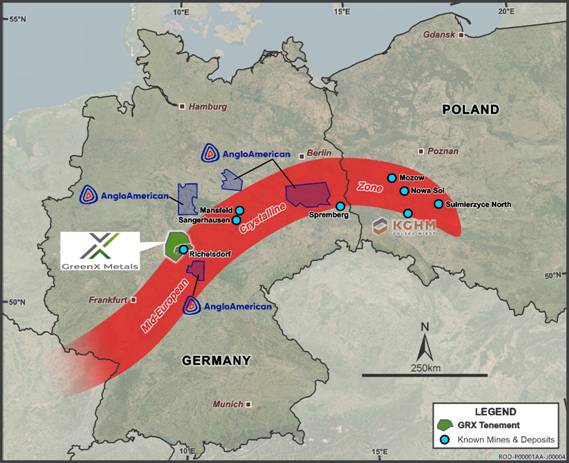
Figure 1: The Tannenberg Copper Project in relation to the locations of key historical and currently operating mines, mineral deposits, and tenements
· Tannenberg Copper Project Acquisition:
o The Company announced the completion of the acquisition of 90% of Group 11 Exploration Gmbh (Group 11 or Vendor) which holds the Tannenberg exploration licences
o Since signing the Joint Venture and Earn-in Agreement (JVA) in 2024, the Project area has expanded seven-fold to cover approximately 1,900 km², comprising the Tannenberg 1 and Tannenberg 2 exploration licences
Greenland – Eleonore North Project
· Targeting Gold, Tungsten & Antimony:
o Outcropping gold and high-grade antimony mineralisation now confirmed at the Noa Prospect within the Eleonore North Project in East Greenland (Eleonore North or ELN)
o High-grade tungsten and antimony mineralisation also identified in Historical Estimate at the Margeries Prospects within the Eleonore North project
§ 83kt of mineralised rock with a mean grade of 4.6% Sb at North Margeries
§ 58kt of mineralised rock grading at 3.2% W at South Margeries
§ 32kt of mineralised rock grading at 1% W at North Margeries
o Potential to identify large scale deposits in new underexplored province with gold mineralisation associated with quartz veining at surface over a length of up to 15 km
o Field activities initially focusing on the shallow gold and high-grade tungsten and antimony potential are currently being finalised for 2026
o Cautionary statement: The Historical Estimates in this announcement are not reported in accordance with the JORC Code. A competent person has not done sufficient work to classify the Historical Estimate as a mineral resource or ore reserve in accordance with the JORC Code. It is uncertain that following evaluation and/or further exploration work that the Historical Estimate will be able to be reported as a mineral resource or ore reserve in accordance with the JORC Code
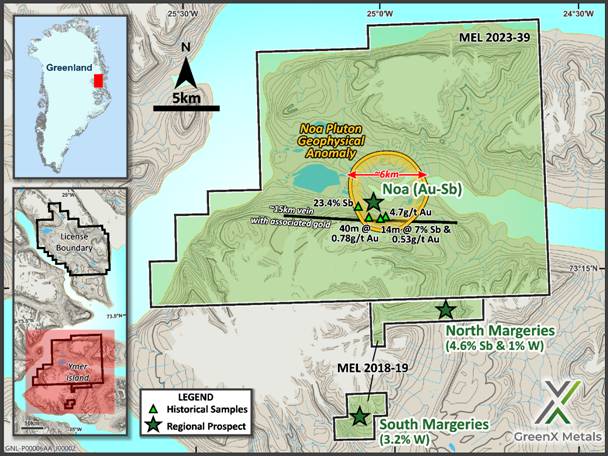
Figure 2: Overview of gold and critical metal prospects within Eleonore North.
· Eleonore North Project 2026 Work Program:
o GreenX will finalise the 2026 exploration program to define and prioritise drill targets, including processing the historical hyperspectral survey and undertaking field mapping/sampling at Noa to ground-truth “reduced intrusion-related gold system” (RIRGS) targets; and at Margeries, collecting bulk samples for W/Sb metallurgical sighter test work, reviewing archived core for re-analysis/metallurgical sampling, and reprocessing historic geophysics/hyperspectral data alongside field mapping to generate drill targets
· Singapore Court Dismissed Poland’s Set-Aside Application
o The Singapore International Commercial Court of the Republic of Singapore (Singapore Court) rejected, in its entirety, the Republic of Poland’s (Poland) application to set aside the Energy Charter Treaty (ECT) award, thereby upholding GreenX’s previously announced right to compensation under the ECT
o As previously advised, in October 2024, GreenX was awarded approximately £252 million (A$519 million / PLN 1.2 billion) in compensation and interest in the Australia-Poland Bilateral Investment Treaty (BIT) award after the Tribunal unanimously held that Poland breached its obligations under the BIT and ECT
o At the time, approximately £183 million (A$378 million / PLN 900 million) was awarded pursuant to the ECT (with payments under one award offset against the other)
o In 2025, Poland lodged a request to set-aside the ECT award in the Singapore Court (having also lodged a request to set-aside the BIT award in the courts of England and Wales in late 2024). The hearing for the ECT set-aside was held in the Singapore Court in July 2025
o Subsequent to the end of the period, the Singapore Court issued a judgment whereby it has rejected, in its entirety, Poland’s application to set aside the ECT award
o The Company has also been awarded A$1.6 million by the Singapore Court that is to be paid by Poland to reimburse the Group for legal costs associated with defending Poland’s failed ECT set-aside motion
o Additional interest of approximately £17 million (A$34 million / PLN 83 million) has already accrued from when the Award was made in October 2024 to end of December 2025 and will continue to compound annually until full and final payment by Poland
o The Company is currently preparing enforcement activities following the Singapore Courts rejection of Poland’s ECT set-aside motion
o In February 2026, Poland appealed the Singapore Courts ECT set-aside rejection. It is expected that this appeal will be dealt with expeditiously by the Singapore appeal court with Poland then having no further rights of appeal through the Singapore courts
· Corporate
o Subsequent to the period, the Company announced that it had completed a placement to raise gross proceeds of approximately A$13.6 million which will be be used for exploration and development activities at the Company’s Tannenberg Copper Project in Germany (Tannenberg) and at Eleonore North, and general working capital, including costs in relation to the Company’s ongoing arbitration proceedings against Poland
Operations
Tannenberg Copper Project (Germany)
Tannenberg is a large scale, relatively shallow and potential high-grade copper brownfields exploration project that is strategically located in the heartland of German industry.
Copper is currently recognised as a strategic raw material by the European Union.
Prior to closure in the 1950’s, the Richelsdorf mines produced 416,500 tonnes of copper and 33.7 million ounces of silver from Kupferschiefer type deposits. These historic mines consisted of shallow underground workings originally accessed from surface outcrops.
Kupferschiefer style deposits are a well-known and prolific subtype of sediment-hosted copper deposit that are the second most prevalent source of copper production and reserves in the world and have been historically mined in Germany and are still mined in Poland.
Germany has been a significant mining jurisdiction in the past and continues its mining tradition, including the K+S potash mines which operate 4 km away from the license area and are located in the State of Hesse.
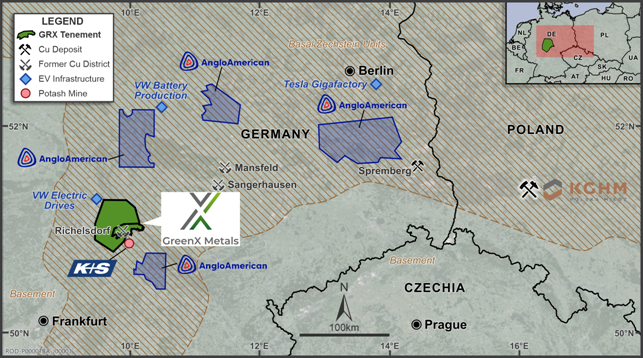
Figure 3: Tannenberg is located in the industrial centre of Europe within the Basal Zechstein trend
(brown shading)
Tannenberg Copper Project Acquisition
During the period, the company announced that completion occurred following exercise of its option to acquire 90% of Group 11, the company which holds the Tannenberg exploration licences.
Since signing the Agreement in 2024, the licence area has expanded seven-fold to cover approximately 1,900 km², comprising the Tannenberg 1 and Tannenberg 2 exploration licences (announced on 28 April 2025). The acquisition of the completed by the Company applies to the entire expanded Project area.
Modern Assays Validate Historical Copper Grades
During the period, the Company announced assay results from its historical core logging and sampling program at Tannenberg. These results further validated historical exploration data from the 1980s and confirmed that mineralisation widths are thicker than those used in the 1940 Historical Estimate (refer to announcement dated 20 October 2025).
The Richelsdorf Mining District has been subject to significant historical drilling, with a 95-hole drilling program completed in the mid-1930s by the National Socialist Government. GreenX discovered the drill database from this program in various German archives (refer to announcement dated 11 September 2025). Subsequent exploration from the 1970s onwards included copper and oil exploration, with archived core available for modern analysis. Historical analysis of the archived cores in the program, typically focused on a narrow 5m-wide interval across the Kupferschiefer shale.
Historical exploration was constrained by the prevailing geological model, which assumed copper mineralisation was syngenetic and restricted to the thin Kupferschiefer shale. This limitation meant sampling focused on a narrow interval, typically only 5m around the Kupferscheifer horizon, rather than the up to 90m intervals that characterise economic Kupferschiefer deposits in Poland today.
The modern understanding of Kupferschiefer copper systems, as demonstrated by KGHM Polska Miedz (KGHM) operations in Poland, supports GreenX’s epigenetic model. KGHM produces over 589,000 tonnes of copper per annum (Source: KGHM Annual Report 2024) from deposits similar to those at Tannenberg, with mineralisation often occurring up to 30m above and 60m below the Kupferschiefer shale horizon. KGHM’s operations are located on the same basement architecture as the Tannenberg Project.
2025 Core Sampling Results
The results announced in this report are historical core assay results where over 90% of historical core was available over the target sample interval that form part of the program. The results have confirmed that mineralisation is present in widths which are thicker than just the narrow Kupferschiefer shale. In this program, mineralisation widths range from 1.0 to 3.7 meters. These results show that the mineralisation is thicker than only the Kupferschiefer strata included in the 1940 Historical Estimate. Not only do these results confirm that the analyses performed by St Joe in the 1980s were accurate, but also that the concept of syngenetic mineralisation restricted to the narrow Kupferschiefer is geologically incorrect. The results are consistent with the expectation that considerably more mineralisation exists at the Tannenberg project than reflected in the 1940 Historical Estimate, which was restricted to reporting mineralisation in the Kupfershiefer shale only (refer to announcement dated 20 October 2025).
Table 1: Results of the 2025 relogging and sampling campaign.
|
Locality |
` |
Intersect (m) |
Cu |
Ag |
Core Recovery |
||
|
From |
To |
Interval |
|||||
|
Ronshausen |
Ro 15 |
285.60 |
289.30 |
3.70 |
1.2 |
17 |
96% |
|
Ro 17 |
481.25 |
482.55 |
1.30 |
1.2 |
24 |
92% |
|
|
Ro 23 |
366.00 |
367.50 |
1.50 |
2.7 |
55 |
93% |
|
|
Ro 25 |
533.38 |
534.39 |
1.01 |
2.0 |
41 |
100% |
|
|
Ro 38 |
536.25 |
538.0 |
1.75 |
0.7 |
15 |
100% |
|
|
Nentershausen |
Ro 45 |
268.0 |
270.37 |
2.37 |
1.4 |
18 |
100% |
Most holes for the six sets of assay results reported are located in the Ronshausen area, where the 1940 Historical Estimate was subsequently validated by the 1980’s Historical Estimate produced by St Joe (refer to announcement dated 20 October 2025). One of the assay results is from hole Ro 45 located near Nentershausen to the north of the area covered by the 1940 Historical Estimate, in the vicinity of the Reichenberg mine.
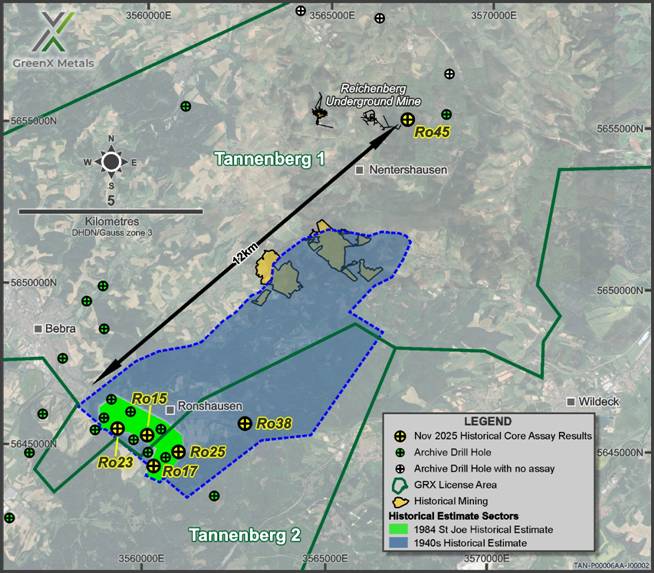
Figure 4: The locations of the historical estimates and the reported assay results from the initial batch of six holes where greater than 90% of the historical core over the target interval was available from the archived core.
Historical Estimate
During the period, the Company announced that it had identified a historical estimate of 728,000 contained tonnes of copper (1,605 Mlbs) at an average grade of 2.6% copper at Tannenberg from 1940 (1940 historical estimate). The 1940 historical estimate was produced by the German company Mansfeldsche Kupferschieferbergbau AG (Mansfeld AG) and is based on the 95-drill hole exploration campaign carried out during the late 1930s (refer to further discussion below).
In addition, a later historical estimate from 1984 was produced by St Joe Exploration GmbH (St Joe), which covers a small part of the same area as the 1940 historical estimate (St Joe’s historical estimate).
The St Joe’s historical estimate is based on limited drilling between 1980 and 1984 (refer to announcements dated 2 August 2024 and 28 April 2025). St Joe’s historical estimate provides further validation for the 1940s historical estimate.
Cautionary statement: The historical estimates in this announcement are not reported in accordance with the JORC Code. A competent person has not done sufficient work to classify the historical estimate as a mineral resource ore reserve in accordance with the JORC Code. It is uncertain that following evaluation and/or further exploration work that the historical estimate will be able to be reported as a mineral resource ore reserve in accordance with the JORC Code.
1940 Mansfeld Historical Estimate
The 1940 historical estimate was calculated by Mansfeld AG according to the relevant German standards applicable during that time. The 1940 historical estimate is based on 18 holes from the 95-hole database generated during the 1935 to 1938 drilling campaign. The original archive document established 728,000 tonnes of contained copper at an average grade of 2.6% copper between the Wolfsberg and Schnepfenbusch mines in the North and the Ronshausen area in the South (Figure 3). The historical estimate covers mineralisation from a depth of 100m in the North to 400m in the Southern end area near Ronshausen.
The 1940 historical estimate covers only the narrow width Kupferschiefer shale mineralisation, which is notable due to the mistaken belief at the time that copper was only present in the distinctive Kupferschiefer shale. Later exploration campaigns have found mineralisation over much wider thicknesses (see 1984 St Joe’s historical estimate section below). This is consistent with GreenX’s exploration hypothesis that historical exploration was mainly based on an outdated deposit model that focused on the 20-60 cm-thick Kupferschiefer shale horizon. The modern understanding of the Kupferschiefer deposit model now shows that up to 95% of mineable copper can be hosted in the footwall sandstone and hanging wall limestone, as evidenced at KGHM Polska Miedź S.A’s Polish mining operations.
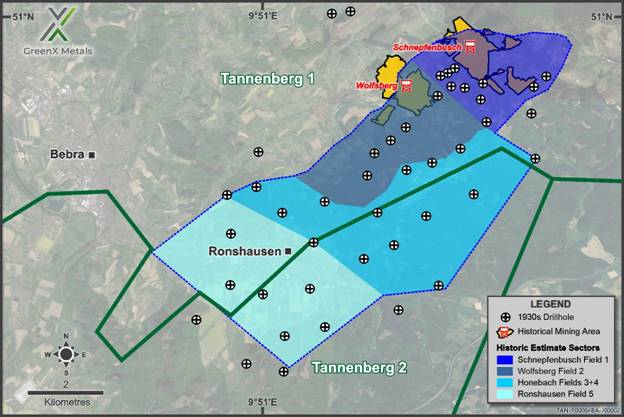
Figure 5: Map showing the locations of the zones of the 1940 historical estimate, related drill holes and historical mining operations
It is also noteworthy that the 1940 historical estimate did not include by-product silver mineralisation. The majority of the mineralisation (463,000 tonnes of contained copper) was found to be present in the Ronshausen region, with gradually decreasing amounts to the North, where the historical mining is to be found (refer Table 2 below).
|
Table 2: Summary of Historical Estimate information from the original 1940 Mansfeld report |
||||
|
Zone |
Surface Area |
Thickness (cm) |
Grade Cu |
Contained Copper |
|
Ronshausen |
10,000,000 |
67.4 |
2.85 |
463,000 |
|
Hönebach |
8,088,000 |
34.2 |
1.92 |
130,055 |
|
Wolfsberg |
6,468,000 |
23.5 |
2.35 |
92,945 |
|
Schnepfenbusch |
5,528,000 |
19.3 |
2.38 |
65,673 |
|
SUB-TOTAL |
|
|
2.59 |
751,673 |
|
Less historical production |
(23,793) |
|||
|
TOTAL |
|
|
|
727,880 |
Cautionary statement: The historical estimates in this announcement are not reported in accordance with the JORC Code. A competent person has not done sufficient work to classify the historical estimate as a mineral resource ore reserve in accordance with the JORC Code. It is uncertain that following evaluation and/or further exploration work that the historical estimate will be able to be reported as a mineral resource ore reserve in accordance with the JORC Code.
The 1940 historical estimate data provides a good level of transparency with regard to the input data and the calculation methods used. The estimation resulting from the drill hole data was cross-checked by Mansfeld AG against the production grades at the Wolfsberg and Schnepfenbusch mines, which were operating in the area at the time of 1940 historical estimate.
The comparison was favourable, and hence the assays from the exploration holes were used. GreenX has reviewed original records covering 17 of the 18 holes (~95%) used for the historical estimation and found no discrepancies.
Mansfeld AG made specific adjustments as part of the 1940 historical estimate to account for sterilisation. A total of 250,000 tonnes of contained copper was omitted to account for areas where surface features might prevent mining. Mansfeld AG also estimated that a further 23,793 tonnes of contained copper had already been extracted by mining at Wolfsberg and Schnepfenbusch (at a production grade of 2.2% Copper). This amount was then subtracted from the historical estimate, as presented in the original source document (refer Table 2 above).
1984 St Joe’s Historical Estimate
Part of the Ronshausen zone of the 1940 historical estimate was drilled by St Joe Exploration during the 1980’s, resulting in recognition of the St Joe’s historical estimate more than 40 years later. Of the many holes drilled by St Joe, a total of 14 holes were used in the estimate of 169,000 of contained copper and 6.5 million ounces of contained silver. The St Joe’s work estimated grades of 2.1 % copper and 25 g/t silver at typical depths between 290 and 370m (Figure 4).
St Joe benefited from both technological advancements and enhanced geological understanding in the 40 years following the work by Mansfeld AG. Consequently, St Joe assayed wider intersections and found that the mineralisation was up to 3.45m width. The historical estimate was calculated using thicknesses of between 1.5 to 2m, considerably thicker than the narrow Kupferschiefer assayed and estimated by Mansfeld AG in 1940.
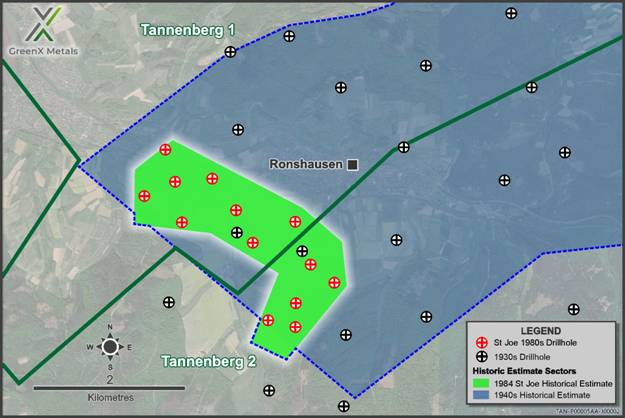
Figure 6: Map showing the drill holes and locations of the Ronshausen zone of the 1940 historical estimate and the relative location of the 1984 St Joe’s historical estimate
Given the increased mineralisation thickness covered by St Joe and the fact that the drilling covered only 28% of the Ronshausen zone, the St Joe’s historical estimate further validates the 1940 historical estimate. The identification of much thicker mineralisation and contained silver also points to considerable exploration upside over all five mineralisation zones covered by the 1940 historical estimate.
Cautionary statement: The historical estimates in this announcement are not reported in accordance with the JORC Code. A competent person has not done sufficient work to classify the historical estimate as a mineral resource or ore reserve in accordance with the JORC Code. It is uncertain that following evaluation and/or further exploration work that the historical estimate will be able to be reported as a mineral resource or ore reserve in accordance with the JORC Code.
Ongoing Exploration Work Programs at Tannenberg
With the acquisition of Tannenberg now complete, GreenX continues to advance a coordinated suite of exploration activities at the Project, which includes:
· Logging, assaying, and hyperspectral scanning of historical core (ongoing);
· Reprocessing and analysis of historical geophysical data (ongoing);
· Collation of historical geological, mine development, and production data (ongoing); and
· Planning for future drilling to verify the historical datasets and expand on the historical estimate in order to establish a mineral resource estimate in accordance with the JORC Code.
Eleonore North Gold and Antimony Project
GreenX has previously announced that high grade antimony mineralisation had been identified at its Eleonore North project in Greenland (Eleonore North or ELN), based on historical results recently released by the Geological Survey of Denmark and Greenland (GEUS). The historical results indicate the potential for a high-grade antimony-gold mineral system at ELN. Antimony prices have been on a rapid uptrend since China announced antimony export controls from 15 September 2024, with antimony prices in the US now having increased to over US$60,000/t from US$18,300/t.
Noa Prospect – potentially large-scale bulk tonnage gold/antimony
The Noa Prospect is located within the ELN Project on exploration licence MEL 2023-39 and has the potential to host a RIRGS, analogous to large bulk-tonnage deposit types found in Canada including Donlin Creek, Fort Knox and Dublin Gulch.
· Gold and antimony mineralisation documented at the high-priority Noa Prospect within Eleonore North
· Geophysical “bullseye” anomaly 6 km wide co-incident with elevated gold and antimony mineralisation from historical geochemical sampling
· Anomalous gold mineralisation associated with quartz veining exposed at surface over a length of up to 15 km
· Historical individual specimens grading up to 23% antimony (Sb), and other samples up to 4g/t gold (Au)
· Previously reported historical data confirmed the presence of gold and high-grade antimony in outcropping veins at ELN, including:
o 14 m long chip sample grading 7.2% Sb and 0.53g/t Au
o 40 m chip line with a length weighed average of 0.78g/t Au
· Antimony mineralisation has been identified along a ~4km trend in veins and structures, that broadly aligns with previously identified gold veining at surface within a 15 km trend
Eleonore North hosts antimony and gold-bearing veins in an area sitting above a geophysical anomaly at Noa interpreted to be a pluton (Figure 5). A passive seismic survey in 2023 showed evidence for multiple blind intrusions rising to just beneath the surface, and processing of results in 3D identified 1-2 km wide elongated plutons, which are priority targets.
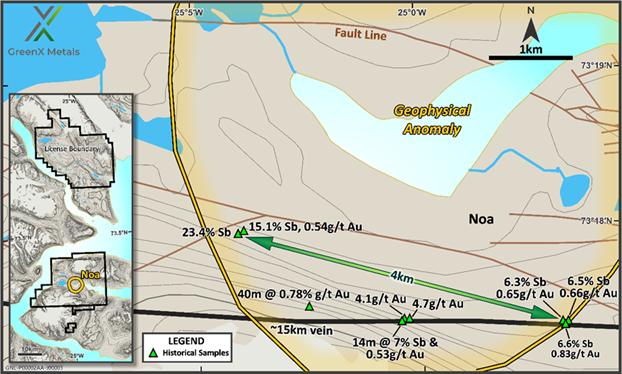
Figure 7: Historical results show evidence for high-grade antimony and gold mineralisation above the interpreted pluton at Noa.
Margeries Prospects – high grade tungsten and antimony Historical Estimate
The Margeries Prospects are also located within the ELN Project on the exploration licence MEL 2018-19 where high grade tungsten and antimony mineralisation has been identified as historical estimates:
· 83 kt of mineralised rock with a mean grade of 4.6% Sb at North Margeries
· 58.1 kt of mineralised rock grading 3.2% W at South Margeries
· 32 kt of mineralised rock grading 1% W at North Margeries
Over 2,000 m of historical drilling has been completed, with core still available in Greenland, together with scoping-level metallurgical test work on tungsten. GreenX will revisit and re-analyse the historical drilling and metallurgical data with an aim to report in accordance with the JORC Code.
Cautionary statement: The Historical Estimate referred to above are not reported in accordance with the JORC Code. A competent person has not done sufficient work to classify the Historical Estimate as a mineral resource or ore reserve in accordance with the JORC Code. It is uncertain that following evaluation and/or further exploration work that the Historical Estimate will be able to be reported as a mineral resource or ore reserve in accordance with the JORC Code.
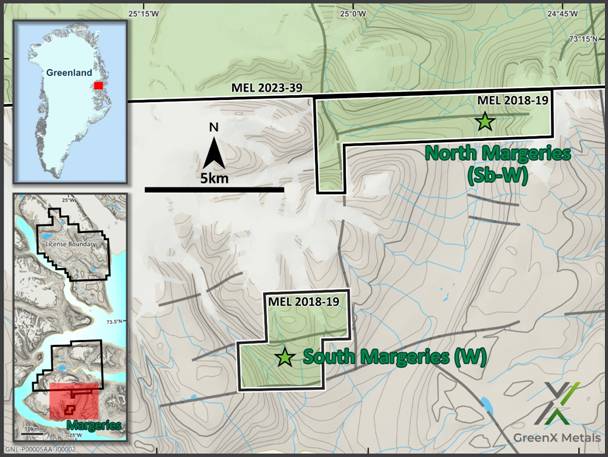
Figure 8: Location map for the Margeries Prospects within MEL 2018-19.
Next steps for Eleonore North (2026 program planning)
Over the coming months, GreenX will finalise the ELN exploration program for 2026 to further define and prioritise potential drill targets, including:
Noa Prospect:
· Process the historical hyperspectral survey
· Field mapping and sampling to ground-truth RIRGS targets and identify drill targets
Margeries Prospects:
· Collect bulk sample material for both tungsten and antimony metallurgical sighter test work
· Inspect the archive core with a view to obtaining samples for re-analysis and metallurgical sighter test work
· Reprocessing of historic geophysics/hyperspectral data and field mapping to identify drill targets
ARCTIC RIFT COPPER PROJECT (ARC) AND JOINT VENTURE
Given the prospectivity and focus on Tannenberg in Germany and at Eleonore North, and following a review of its portfolio of projects and the most efficient and effective use of the Company’s resources, GreenX has agreed to wind up the ARC joint venture and as a result it has fully impaired the exploration and evaluation asset. The Company is currently in the process of relinquishing the ARC exploration licence held in Greenland and winding up the joint venture entity which is now expected to be completed in the second half of 2026.
Singapore Court Dismisses Poland’s Set-Aside Application
Subsequent to the period, the Company announced that the Singapore Court rejected, in its entirety, Poland‘s application to set aside the ECT award, thereby upholding GreenX’s previously announced right to compensation under the ECT.
In January 2025, Poland lodged a request to set-aside the ECT award in the Singapore Court challenging jurisdictional aspects of the ECT award and alleged procedural unfairness in the Tribunal’s decision on damages.
GreenX advised that the Singapore Court has now issued a judgment whereby it has rejected, in its entirety, Poland’s application to set aside the ECT award.
The Company has also been awarded A$1.6 million by the Singapore Court that is to be paid by Poland to reimburse the company for legal costs associated with defending Poland’s failed ECT set-aside motion.
A redacted judgment has been released by the Singapore Court. The Company intends to bring the judgment to the attention of the English courts as part of the BIT set-aside proceedings. In February 2026, Poland applied to the Court of Appeal of the Republic of Singapore to appeal the Singapore Courts rejection of its ECT set-aside motion. It is expected that this appeal will be dealt with expeditiously by the Singapore appeal court with Poland then having no further rights of appeal. The threshold to succeed on a set aside motion in either the Singapore or English courts is very high, with the courts rejecting set-aside applications in the vast majority of cases.
The Company is currently preparing enforcement activities following the Singapore Courts rejection of Poland’s initial ECT set-aside motion.
The Company will continue to defend its awards and update the market in line with its continuous disclosure requirements.
Corporate
Subsequent to the period, the Company announced that it had successfully completed a bookbuild and secured firm commitments for a placement to raise gross proceeds of approximately A$13.6 million.
The net proceeds from the placement will be used for exploration and development activities at Tannenberg and Eleonore North, and general working capital, including costs in relation to the Company’s ongoing arbitration and set-aside proceedings against Poland.
Directors
The names and details of the Company’s Directors in office at any time during the half-year and until the date of this report are:
Directors:
Mr Ian Middlemas Chairman
Mr Benjamin Stoikovich Director and CEO
Mr Garry Hemming Non-Executive Director
Mr Mark Pearce Non-Executive Director
Unless otherwise shown, all Directors were in office from the beginning of the half-year until the date of this report.
Results of Operations
The net loss of the Consolidated Entity for the half-year ended 31 December 2025 was $8,212,005 (31 December 2024: $2,092,947). Significant items contributing to the current half-year loss and the substantial differences from the previous half-year include to the following:
(i) Arbitration related expenses of $1,017,518 (31 December 2024: $723,787) relating to the ongoing claim against Poland including set-aside defence costs (which are currently unfunded). This has been offset by the arbitration funding income of nil (31 December 2024: $251,593);
(ii) Exploration and evaluation expenses of $824,077 (31 December 2024: $338,762), which is attributable to the Group’s accounting policy of expensing exploration and evaluation expenditure incurred by the Group subsequent to the acquisition of rights to explore and up to the commencement of a bankable feasibility study for each separate area of interest;
(iii) Non-cash share-based payment expense of $587,011 (December 2024: $81,000) due to incentive securities issued to key management personnel and other key employees and consultants of the Group as part of the long-term incentive plan to reward key management personnel and other key employees and consultants for the long-term performance of the Group;
(iv) Business development expenses of $272,773 (31 December 2024: $314,855) which includes expenses relating to the Group’s review of new business and project opportunities; including business development costs for the Tannenberg transaction in the prior period, plus also investor relations activities during the six months to 31 December 2025 including public relations, digital marketing, and business development consultant costs;
(v) Exploration and evaluation asset impairment of $4,415,000 (31 December 2024: nil), relating to the impairment of the exploration and evaluation asset previously recognised in relation to the ARC project as a result of the Company agreeing to wind up the ARC joint venture and relinquish the exploration licence in Greenland; and
(vi) Interest income of $76,189 (31 December 2024: $141,391) earned on cash and cash equivalents held by the Group.
Financial Position
At 31 December 2025 the Company had net assets of $6,819,371 (30 June 2025: $14,322,747) a decrease of approximately 53% compared with 30 June 2025. This is largely attributable to expenditure on the arbitration related expenses and decrease of the exploration and evaluation asset following the impairment of ARC. Subsequent to the end of the period, the Company completed a placement to raise gross proceeds of approximately $13.6 million. Following the completion of the placement, the Company had cash reserves of approximately $14.6 million.
Link here for full financial statements