 First Class Metals PLC (“First Class Metals”, “FCM” or the “Company”) the UK listed company focused on the discovery of economic metal deposits across its exploration properties in Ontario, Canada, is pleased to report the final, cumulative drill results for the Roy drilling programme on the Sunbeam Property.
Highlights
· Bonanza-grade gold confirmed in diamond drill hole (DDH) SUN26-05 by double Fire Assays (“FA”), validating the previously reported Photon Assay (“PA”) results
· Gold mineralisation confirmed over approximately 300m of strike, with anomalous to potentially ore-grade gold values, remaining open along strike and at depth
· Recent structural interpretation indicates the Roy Prospect forms part of the district-scale Nahanni Shear Zone (“NSZ”), considered comparable in geological setting to the Marmion Shear Zone (‘MSZ’), host to the 3.3Moz Hammond Reef gold deposit
· Drilling has tested approximately 300m of strike, representing around 1% of the interpreted Nahanni Shear Zone , leaving the vast majority of the prospective structural corridor untested
· The Very Low Frequency (‘VLF’) geophysical and soil survey grid from 2025 has now been extended by approximately 1.5km to the northeast along strike.
· Exploration work continues at the parallel Pettigrew trend, applying the structural model developed at Roy to generate drill targets.
· An Exploration Permit application has been submitted for winter drilling on the frozen lake adjacent to Roy
· Quote has been sought for detailed airborne geophysics over the core area of the property.
Marc J. Sale CEO First Class Metals Commented:
“The final assay results from the drilling at Roy have confirmed our belief in the potential for the Roy trend. The visible gold presence is supported by both photon and fire assay analysis, giving us further confidence in the high-grade nature of the mineralisation.
We are building on the information derived from the drilling, the VLF and the soil survey to refine follow up drill targets along the trend as well as the area of potential high-grade mineralisation at Roy. Importantly, the programme has also significantly improved our understanding of the wider Nahanni Shear Zone, of which we have only tested a very small proportion to date.
In parallel we are applying the knowledge gleaned from Roy to Pettigrew where data collating is ongoing as well as a detailed VLF and soil sampling survey. All this information will form the basis for drilling at Pettigrew as well as eventually the wider property.”
Roy structure
Recent geological mapping and structural interpretation has significantly enhanced FCM’s understanding of the Sunbeam Property. The Roy, Pettigrew and Sunbeam trends are now interpreted to form part of a major district-scale shear system, referred to as the NSZ.
The name NSZ was first proposed by Ferri[1] following mapping of the Sunbeam/Road zone area for Nuinsco in 2021. Building on this work and the exploration conducted by Emerald Geological Services (‘EGS’), FCM’s consulting geologist, Chris Cooper, believes the morphology of the NSZ can be compared to the Marmion Shear Zone, see Figure 1.
The MSZ hosts the 3.3Moz Hammond Reef gold deposit, (cutoff grade is 0.41g/t). Whilst there can be no assurance the NSZ hosts a deposit of similar scale, the structural similarities significantly enhance the Company’s confidence in the exploration potential of the wider Sunbeam Property.
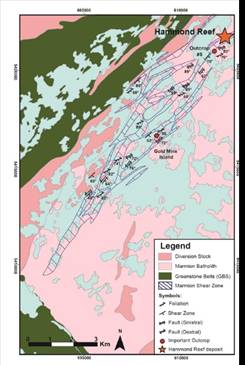
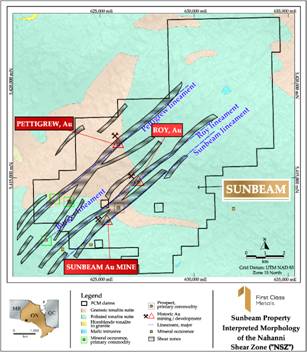
Figure 1 showing the Marmion shear zone, MSZ hosting the 3.3M oz Au Hammond reef deposit on the left[2] and the proposed Nahanni shear zone NSZ on the Sunbeam property on the right.
This represents a significant advance in understanding the structural controls on mineralisation across Sunbeam. Importantly, the completed drill programme has tested only approximately 1% of the interpreted Nahanni Shear Zone, highlighting the considerable exploration upside that remains across the wider system
Roy drilling
The results are now available for the ~1,000m drill programme at Roy on the Sunbeam property.
FCM management considers the programme an outstanding success with 11 of the 12 holes intersecting the targeted ‘structure’. The other hole was designed as a scissor to confirm the dip of the target zone and by so doing support the drill hole orientation – the azimuth, being used.
The potentially mineralised package occupying the structure extends for a strike length of 300m, see Figure 2 and remains open along strike to the northeast and southwest, as well as at depth.
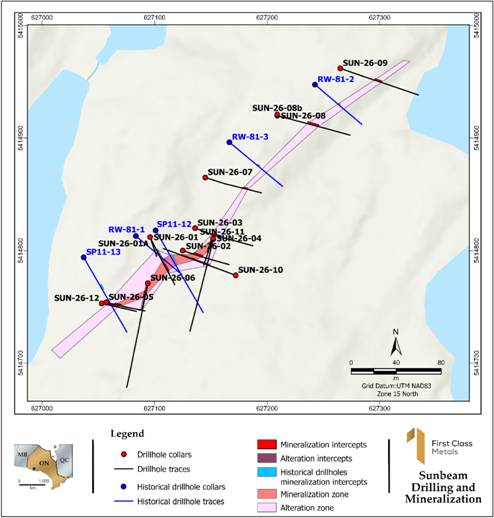
Figure 2 showing the 12 drill holes at Roy with initial interpretation of the potentially mineralised package which extends over 300m, as well as in deep red the higher grade core zone.
Drill results
The Fire Assay for all the drill holes have been received, including the visible (“VG”) samples.
Initially the three samples which were identified as containing VG were submitted for photon assay, as this method analyses the whole sample and is therefore more representative as well as being non-destructive. Subsequently the same samples along with the rest of the sampled core from holes SUN26 05 – 26 12 were analysed by fire assay, which uses only about 50g of the total sample. A second ‘check’ FA was also performed on each of the three VG samples, including the sample which returned the previously reported assay of 45 g/t Au by PA from hole SUN26 05.
The FA results supported the PA results, in so much in hole SUN26 05 the average of all three assays (PA+FA+FA) was 40.2g/t Au. The results from hole SUN26-06 were similarly supported.
The assays have confirmed several important aspects of the Roy mineralisation
· The potential for high-grade intersections in the Roy structure / package, with SUN26-05 reporting 5.1m @ 4.14g/t Au from 13.9m depth, containing the VG sample with 45g/t Au
· Potential for broad low-grade zones (bulk tonnage) with SUN26-05 reporting 16.95m @ 0.45g/t Au from 5m (note this is oblique to the mineralisation) and
o in hole SUN26-06 3m @ 0.27g/t Au from 53.3m, and
o in hole SUN26-01A 8.5m @ 0.45g/t Au from 43.5m and
o in hole SUN26-02 9.5m @ 0.49g/t Au from 16.67m and
o in hole SUN26-11 5.1m @ 0.67g/t Au from 8.9m;
o in hole SUN26-12, 5.4m @ 0.227g/t Au from 13.6m
o as well as 4.6m @ 0.54g/t Au from 20.6m
· Hole SUN26-09, the most northerly hole also contained anomalous gold, indicating the potentially gold bearing ‘package’ has an open in all directions strike of >300m
· Central core area of about 100m extent, containing the higher gold values identified to date, see the red zone in Figure 2, which represents a priority target for follow up drilling
Further study of the core is planned as there is additional potential for VG in the half core that was not sampled. As well there are ‘outlier’ values, for example:
· @32.0m in hole SUN26-06: 1.2g/t over 1.0m
· @50.6m in hole SUN26-08: 1.04g/t Au over 0.7m
· @57.6m in hole SUN26-10: 1.18g/t Au over 0.5m
These anomalous ‘sample points’ require further investigation during an overall review of the drill core and to further augment the structural controls on the mineralisation.
Ongoing exploration
The Roy trend has now been confirmed, through historic work and prospecting / soil sampling by EGS, over 3km of strike towards the 111ppb lake sediment sample.
The recently completed, combined soil and VLF survey grid extends almost 5km from the Roy mine shaft area, to the northeast, see Figure 3.
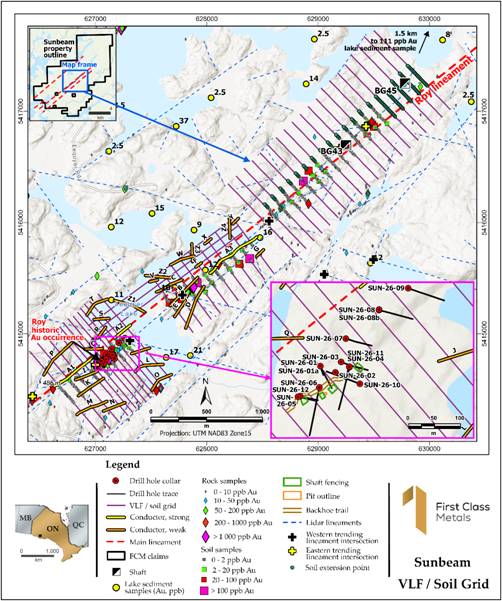
Figure 3 Showing the soil (and coincident VLF) grid, locations of historic shafts, including Roy, and drill holes around the Roy shaft as well as the strike extension to the NE.
As previously stated, the gold is seen in association with galena, potentially an important pathfinder. When the lead (Pb) and gold are plotted on the soil grid anomalous values indicate several ‘bullseyes’ along strike. The current work in the northeast is designed to prove further continuity of this model.
FCM has approached a renowned Toronto based, international geophysics company for a quote for a detailed geophysics survey over the central area of the Sunbeam property. It is intended if accepted and executed that the interpretation will include the ground-based VLF as well as the soil data from both Roy and Pettigrew.
Work on the parallel lineament that hosts the Pettigrew development continues with a combined VLF and soil survey as well as intense structural mapping of the stripped areas.
The growing understanding of the structural controls to the mineralisation gleaned from the geological investigations at Roy and ongoing work around the Pettigrew shafts and pits will be collated to form the basis of a drill proposal at Pettigrew as well as recommendations for follow up drilling at Roy. To this end an Exploration Permit has been lodged with the Ministry requesting drill holes ‘on the ice’ to allow step back – deeper drilling at Roy.
Qualified Person
The technical disclosures contained in this announcement have been drafted in line with the Canadian Institute of Mining, Metallurgy and Petroleum standards and guidelines and approved by Marc J. Sale, who has more than 30 years in the gold exploration industry and is considered a Qualified Person owing to his status as a Fellow of the Australian Institute of Mining and Metallurgy.
Glossary of Technical Terms
|
Term |
Explanation |
|
Alteration |
Chemical changes to rock caused by mineralising fluids, often associated with ore-forming processes. |
|
Assay |
Laboratory analysis used to determine the concentration of metals within a rock sample. |
|
Azimuth |
The compass direction in which a drill hole or geological feature is oriented, measured in degrees from north. |
|
Core |
Cylindrical rock recovered during diamond drilling, used to examine geology and mineralisation. |
|
Diamond Drill Hole (DDH) |
A hole drilled using a diamond drill bit to recover continuous rock core for geological logging, sampling and analysis. |
|
Fire Assay (FA) |
The industry-standard laboratory analytical method that uses high-temperature fusion to separate and concentrate precious metals, such as gold and silver, from a sample for accurate determination of their concentrations laboratory method for determining gold content in a sample. Typically only a small sub-sample (commonly 50g) is analysed. |
|
Galena |
A lead sulphide mineral (PbS) that can be associated with precious metal mineralisation in some geological systems. |
|
LiDAR |
Light Detection and Ranging, a remote sensing technique that uses laser pulses to produce highly detailed maps of surface topography. |
|
Logging |
The detailed geological description and recording of drill core, including rock type, alteration and mineralisation. |
|
Mineralised Package |
A sequence of rocks containing minerals associated with potential economic metal deposits. |
|
Photon Assay (PA) |
A non-destructive analytical method that measures the gold content of an entire sample using photon activation, reducing sampling bias associated with coarse or visible gold. |
|
Quartz Vein |
A fracture or crack in rock that has been filled with quartz. Quartz veins are commonly associated with gold mineralisation. |
|
Sampling |
The process of cutting and collecting sections of drill core for laboratory analysis to determine metal content. |
|
Schist |
A metamorphic rock characterised by strong foliation and aligned mineral grains. |
|
Strike |
The compass direction of a geological feature, such as a vein or shear zone, measured along its horizontal extent. |
|
Strike Length |
The horizontal distance over which a geological structure or mineralised zone can be traced. |
|
Structure / Structural Zone |
A geological feature, such as a fault or shear zone, that may control the movement of mineralising fluids and the location of mineral deposits. |
|
Tonalite |
A coarse-grained intrusive igneous rock similar to granite, commonly found in mineralised geological terranes. |
|
Visible Gold (VG) |
Gold that can be seen with the naked eye in drill core or rock samples. Visible gold does not necessarily indicate economic grades but is considered a positive indicator in gold exploration. |
For Further Information:
Engage with us by asking questions, watching video summaries, and seeing what other shareholders have to say. Navigate to our Interactive Investor hub here: https://firstclassmetalsplc.com/link/rLz96y
For further information, please contact:
James Knowles, Executive Chair
Email: JamesK@Firstclassmetalsplc.com
Tel: 07488 362641
Marc J Sale, CEO and Executive Director
Email: MarcS@Firstclassmetalsplc.com
Tel: 07711 093532
AlbR Capital Limited (Financial Adviser)
David Coffman/Dan Harris
Website: www.albrcapital.com
Tel: (0)20 7469 0930
Axis Capital Markets (Broker)
Richard Hutchinson
Website: Axcap247.com
Tel: (0)203 026 0449