 GreenX Metals Limited (ASX:GRX, LSE:GRX, GPW:GRX, Germany-FSE:A3C9JR) (GreenX or the Company) is pleased to present its Quarterly Activities Report for the period during and subsequent to 30 September 2025.
HIGHLIGHTS
· GERMANY – TANNENBERG COPPER PROJECT
· HISTORICAL ESTIMATE:
o The Company announced an historical estimate of 728,000 tonnes contained copper (1,605 Mlbs) at an average grade of 2.6% copper on part of the Tannenberg Copper Project (Tannenberg or Project) licence area
§ Estimate based on a 1935-1938 National Socialist Government drilling campaign across four zones: Ronshausen, Hönebach, Wolfsberg and Schnepfenbusch
§ Drilling targeted the thin Kupferschiefer horizon only
§ Focused only on copper and did not include by-product metals
o Independent company St Joe Exploration GmbH conducted limited drilling between 1980 and 1984, further validating the 1940 historical estimate
§ Drilling focused on only 28% of the Ronshausen zone but included by-product silver
§ Drilling identified up to 3.45m thick mineralisation straddling the Kupferschiefer and the limestone hanging wall and sandstone footwall above and below the Kupferschiefer
§ 1984 historical estimate shows consistent grades of 2.1% copper plus 25 g/t silver with 169,000 tonnes of contained copper and 6.5 million ounces of silver
o Exploration upside potential under modern interpretation: St Joe Exploration confirmed thicker widths of copper and silver mineralisation at Ronshausen, and more may exist up to 30m above and 60m below the Kupferschiefer in the limestone hanging wall and sandstone footwall
§ Hypothesis is consistent with modern understanding of the Kupferschiefer deposit model as demonstrated at KGHM’s Polish mining operations which are also found on the same geological structure as the Tannenberg Project.
o GreenX is currently relogging and resampling over 4km of archived core from 47 holes to upgrade historical data to modern standards
§ Investigation of German mining archives and the digitisation of original historical data continues
§ Planning of future twin drilling campaign to verify the historical estimates, and to establish a mineral resource estimate in accordance with the JORC Code (2012) (JORC Code)
o Cautionary statement: The historical estimates in this announcement are not reported in accordance with the JORC Code. A competent person has not done sufficient work to classify the historical estimate as a mineral resource or ore reserve in accordance with the JORC Code. It is uncertain that following evaluation and/or further exploration work that the historical estimate will be able to be reported as a mineral resource or ore reserve in accordance with the JORC Code.
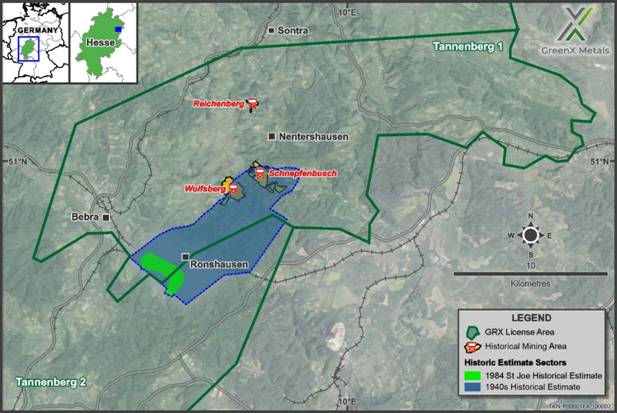
Figure 1: Map showing the location of the zones of the historical estimates and historical mining operations
· HISTORICAL DRILL DATABASE:
o Drilling database comprising 95 drillholes from 1930s exploration discovered in German archives, providing data that represents significant cost and time savings for the ongoing Tannenberg exploration program
o Original detailed geological documentation recovered for 43 drillholes to date, including lithological descriptions, stratigraphic interpretations and other comprehensive data
o Historical assay results located so far for 35 drillholes covering copper, silver, lead, and zinc, with additional sporadic assays for nickel, cobalt, molybdenum, and vanadium
o Archive search program expanded to locate additional drillhole data including German national archives, provincial archives in former East German states and private collections
o Integration of digitised drill logs into GreenX drillhole database and 3D geological models underway to support ongoing exploration activities
· AEROMAG RESULTS IDENTIFY PRIMARY COPPER SOURCE:
o Successful completion of 58km2 airborne magnetic and radiometric survey over the Tannenberg Project, covering the brownfields Richelsdorf copper district, which produced 416,500 tonnes of copper at grades of between 0.8 and 1.2%1 (1800s to 1950s)
o Major geological insight gained with identification of deep metal source structures directly below the historic Richelsdorf mines, following the first modern exploration completed in 40 years
o Mid-European Crystalline Zone (MECZ) identified beneath the mining district – the same geological structure understood to be the primary source of copper in the Kupferschiefer deposits across the European Copperbelt in Germany and Poland
o Large-scale anomalies extend beyond survey area into the Tannenberg 2 licence, significantly increasing exploration potential
ENQUIRIES
|
Ben Stoikovich +44 207 478 3900
|